Home/Services/Roof Soft Washing
Roof soft washing in the Oklahoma City metro
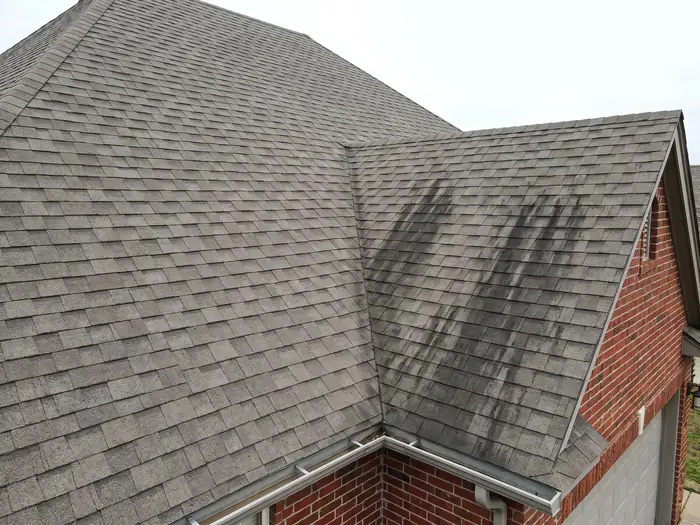
The black streaks running down your shingles are algae, not age. A low-pressure soft wash kills the growth and rinses it away. A pressure washer never touches the roof, because on shingles that's how you buy a new roof early.
What we clean
- Asphalt shingle roofs
- Black algae streaking
- Moss & lichen spots
- Ridge lines & valleys
- Dormers & porch roofs
The streaking is Gloeocapsa magma, an airborne algae that feeds on the limestone filler in modern shingles. It lands, takes hold, and spreads downhill with the rain. That's why the streaks always run vertically and why the north-facing plane usually looks worst.
Beyond looks, a colonized roof holds moisture and heat against the shingles. Cleaning it isn't cosmetic maintenance so much as slowing down the thing that's eating your roof's filler.
How we do it
A roof soft wash is applied at low pressure, closer to a heavy rain than a pressure washer. The solution sits on the shingles while it kills the algae, moss and lichen, then gets rinsed gently. No surface is blasted, no granules are stripped, and we stay off the shingles as much as the roof line allows.
High pressure would do the opposite: shear off the granule layer that protects the shingle from UV and hail, taking years off the roof to make it look clean for one season. Shingle manufacturers specify low-pressure chemical cleaning for exactly this reason.
Gutters catch everything the roof sheds, so they get flushed as part of the job, and the landscaping under the drip line stays watered the whole time.
Half done, same roof
Streaked on one side, soft washed on the other. The clean half isn't new shingles — it's the same roof with the algae gone.
What it costs
Roof washing is priced by the job, and the price depends on the roof's size and pitch, how established the growth is, and how much of it we can reach without walking the shingles. We give you a firm price after looking at the roof from the ground, and that's the number you pay.
Roof questions, answered straight
What are the black streaks on my roof?
The black streaks on asphalt shingle roofs are Gloeocapsa magma, an airborne algae that feeds on the limestone filler inside the shingles. It isn't dirt and it doesn't wash off in the rain — it's alive, it spreads downhill with runoff, and it comes off with a soft wash that kills it.
Why can't you just pressure wash a roof?
High pressure strips the protective granules off asphalt shingles, and those granules are the shingle's defense against UV and hail. A pressure-washed roof looks clean for a season and ages years faster. Shingle manufacturers specify low-pressure chemical cleaning for exactly this reason. A soft wash is how you clean a roof without shortening its life.
How long does a roof stay clean after a soft wash?
Roofs run on a longer cycle than concrete or siding. Because the soft wash kills the algae colony rather than trimming it, most roofs stay streak-free for several years before the growth re-establishes. Shaded roof planes and homes under trees see it return sooner than open, sun-exposed roofs.
Do you walk on the roof?
We walk on the roof as little as possible. Most of the application and rinse happens from ladders and the roof edge. Staying off the shingles is better for the roof and safer for everyone, and it's one of the practical advantages of cleaning chemically instead of with pressure.
Will the runoff hurt my gutters or landscaping?
Everything the roof sheds passes through the gutters and downspouts, so we flush them as part of the job and keep the landscaping underneath watered before, during and after the wash. Tell us about anything delicate near the downspouts during the walkthrough.
Lose the streaks, keep the roof
Call or text 405-240-7848, or send a few details and a photo of the roof line.